Research / Children’s healthCleaner air. More room to grow.
Association of Improved Air Quality with Lung Development in Children
New England Journal of Medicine · W. James Gauderman et al. · March 2015
Researchers measured lung function in 2,120 children across three Southern California cohorts. Declines in nitrogen dioxide and particle pollution were associated with better lung growth from ages 11 to 15.
Read the original source ↗Context & questions
This observational study concerns regional air pollution from multiple sources, not LNG-specific exposure. It supports the value of cleaner air for developing lungs; it does not estimate effects from Woodfibre LNG or establish a safe distance from a facility.
A question to take forward
How can baseline monitoring account for the air children breathe at home, at school and while playing outdoors?
Moms’ health matters, too.
Associations between Air Pollution Exposure and Blood Pressure during Pregnancy among PRINCESA Cohort Participants
Toxics · Miatta A. Buxton et al. · May 2023
A Mexico City pregnancy study examined air pollution and blood pressure by trimester. It found associations between higher nitrogen dioxide or fine-particle exposure and higher blood pressure in some analyses; patterns varied by pollutant, exposure level and trimester.
Read the original source ↗Context & questions
This is observational research on urban air pollution, not an LNG study. Relationships were nonlinear, and higher blood pressure with higher pollution was found only in the below-median exposure range for certain pollutant–trimester combinations. It does not establish that Woodfibre emissions would cause hypertension or preeclampsia.
A question to take forward
How will local health assessments consider pregnant people’s own health, alongside birth outcomes?
A living world beneath the surface.
Glass sponge aggregations in Howe Sound: locations, reef status, and ecological significance assessment
Fisheries and Oceans Canada · Canadian Science Advisory Secretariat · May 2018
DFO’s assessment documents glass sponge habitats in the Howe Sound and their ecological importance. These reefs filter water, process nutrients and provide habitat for fish and invertebrates.
Read the original source ↗Context & questions
This is local ecological evidence and a historical assessment, not proof of damage from LNG. It establishes why reef condition and habitat protection matter. Current condition, project interactions and monitoring require additional site-specific information.
A question to take forward
What baseline surveys and independent monitoring will track sensitive habitats, sediment disturbance and changes over time?
A quieter ocean matters for feeding.
Evidence for ship noise impacts on humpback whale foraging behaviour
Biology Letters · Hannah B. Blair et al. · August 2016
Tag data from humpback whales in the western North Atlantic linked higher ship noise with changes in feeding behaviour, including fewer bottom-feeding rolls per dive.
Read the original source ↗Context & questions
A small observational study of bottom-feeding whales in a different ecosystem. It does not quantify effects on whales in the Howe Sound, isolate LNG vessels or demonstrate a population decline. Species behaviour, received noise and local vessel traffic need to be considered.
A question to take forward
How will underwater noise and marine mammal activity be monitored across construction, vessel movements and ongoing operations?
Startup deserves a closer look.
Analysis of Flaring Activity at Liquefied Natural Gas (LNG) Export Facilities Worldwide
Environmental Science & Technology · Laura Minet et al. · September 2025
Researchers examined ten years of satellite data for 48 LNG export facilities. Estimated flared-gas volumes were higher during the first two years of operation, and flaring varied widely between facilities.
Read the original study ↗Context & questions
This LNG-specific study estimates flaring activity; it does not measure residents’ exposure or health outcomes. Satellite detection and gas-volume estimates have uncertainties, and global averages do not predict Woodfibre’s operations. Kate McInnes is a co-author.
A question to take forward
How do Woodfibre’s assessments and monitoring plans account for startup, maintenance and unusually high flaring?
LNG emissions and children’s lungs.
Assessing Near-Source Health and Equity Impacts of Liquefied Natural Gas Terminals
GeoHealth · Xinran Wu et al. · April 2026
A study of four U.S. LNG terminals modelled nitrogen dioxide exposure and associated health burdens, including childhood asthma. It adds LNG-specific evidence to questions about nearby communities’ air.
Read the original study ↗Context & questions
The study combines air-dispersion modelling with published exposure–health relationships. Its health burdens are estimates, not observed diagnoses attributed to the terminals. The health relationships were derived largely from traffic-pollution research. Different facilities, emissions and weather mean these estimates cannot be transferred to the Howe Sound.
A question to take forward
Which local nitrogen dioxide measurements and emissions data would help assess potential impacts on children here?
What flaring could mean for pregnancy
Flaring and birth outcomes in South Texas
Environmental Health Perspectives · 2020 · peer-reviewed study
The UCLA–USC study linked high flaring exposure within 5 km of homes during pregnancy with 50% higher odds of preterm birth. It studied an oil-and-gas production region in Texas, not Woodfibre LNG.
Read the original source ↗UCLA’s plain-language summary ↗
Context & questions
An observational study in an oil-and-gas production region. It cannot establish causation or quantify risk from Woodfibre LNG in the Howe Sound.
A question to take forward
Which local exposure data and health expertise are needed to assess relevance to the Howe Sound?
Why operating limits need scrutiny
Gas flaring far exceeds permitted volumes
The Canadian Press · Lauren Krugel · April 9, 2026
Reporting on four months of filings gives average permit-volume multiples of 45× (warm/wet), 40× (cold/dry) and 5× (storage/loading). LNG Canada said increased flaring was part of early operations and would decline in regular operation.
Open the supplied CBC article ↗Verified Canadian Press report — CityNews ↗
Context & questions
These are category-specific averages for October 2025–January 2026, not a single facility-wide multiplier or a health-risk calculation. The supplied CBC page could not be retrieved; the figures were checked against the Canadian Press report carried by CityNews.
A question to take forward
What limits apply during startup, equipment failures and regular operation—and what happens after an exceedance?
Why equipment reliability matters
Equipment problems behind excessive flaring
The Narwhal · Matt Simmons & Lauren Watson · January 21, 2026
Documents described at least 170,000 m³/day needed to manage a flare integrity issue, versus a typical 11,000 m³/day. The regulator reported an average of about 205,000 m³/day for July–November 2025.
Read the original source ↗Context & questions
These figures have different reference periods and purposes. The regulator said added gas mitigated the integrity issue; the company described early-operation flaring as normal. Neither statement measures residents’ exposure.
A question to take forward
How quickly must equipment problems, interim controls and repair timelines be disclosed?
What happens when pollution controls fail?
When an acid gas incinerator goes offline
The Tyee · Zoë Yunker · July 20, 2026
One unit’s incinerator was reportedly offline for 139 days between September 2025 and April 2026. Pre-operation modelling anticipated outages around once a year for four to six hours.
Read the original source ↗Context & questions
During outages, acid gas was sent to a flare with added fuel. The company and regulator defended destruction performance; an interviewed chemical engineer disputed equivalence with controlled incineration. Downtime alone does not quantify ambient exposure.
A question to take forward
What operating restrictions and independent checks apply when pollution-control equipment is unavailable?
Why we need to know what is in the air
What are Kitimat residents breathing?
The Tyee · Zoë Yunker · July 21, 2026
An investigation described symptoms reported by residents and gaps in pollutant-specific monitoring. Its Riverlodge comparison covered non-methane hydrocarbons and 37 Alberta stations.
Read the original source ↗Context & questions
The article did not establish a causal link between residents’ illnesses and LNG Canada. Hydrocarbons are a broad category, not benzene alone. The company and regulator said increased flaring had not measurably affected local air quality. This July snapshot should not be read as a complete account of later monitoring changes.
A question to take forward
Which compounds are measured individually, at what detection limits, locations and sampling intervals?
How the health study reached the local debate
Greens call for a halt to Squamish LNG plans
Vancouver Sun · Tiffany Crawford · June 9, 2023; updated June 10, 2023
Article text reviewedThe article reports B.C. Green calls to pause Woodfibre LNG and commission independent health research after attention to the UCLA–USC flaring study. Woodfibre LNG said its single liquefaction facility differs from the Texas oil-and-gas production setting and was designed to minimize flaring.
Read the article — Vancouver Sun ↗Context & questions
This is reporting from June 2023, not a new study or a current statement of project operations. The underlying pregnancy study is the same 2020 paper linked elsewhere in this collection, not independent additional evidence. We use that paper’s exposure definition: nightly flare events counted within 5 km over pregnancy, rather than interpreting the article as a requirement for 10 flares every night.
At the time, the company said flaring would occur in emergencies or certain maintenance procedures and cited the regulatory assessment’s finding of no significant local air-quality impact. These are attributed company statements, not a new independent finding.
A question to take forward
How do current permit conditions and local health assessments address the evidence and concerns raised since 2023?
Article text checked against the reader-supplied publisher PDF on October 23, 2026. Original publication remains with Vancouver Sun.
What local health research could help answer
Scientists to study health impacts of Squamish’s LNG plant
CBC News · David P. Ball · February 20, 2024
Article text reviewedCBC reported plans for federally funded research involving Vancouver Coastal Health and four universities. Researchers planned to combine local airflow and pollution modelling with satellite flaring data from five overseas LNG terminals, including consideration of the Howe Sound’s weather and terrain.
Read the article — CBC News ↗Context & questions
The article describes a study due to begin in March 2024; it does not present completed study results or measured health effects from Woodfibre LNG. The participating universities named are Victoria, Simon Fraser, Toronto and Texas A&M.
Researchers discussed uncertainty about actual flaring and local conditions, including inversions that can trap pollution near the ground. Woodfibre LNG said its design would minimize flaring; the Environmental Assessment Office said its original assessment predicted ground-level contaminants below provincial objectives under normal operations and unplanned incidents.
A question to take forward
What findings have since been published, and how will they inform baseline monitoring, permit conditions and public reporting?
Article text checked against the reader-supplied publisher PDF on October 23, 2026. Original publication remains with CBC News.
The evidence extends beyond one pregnancy study.
The human health effects of unconventional oil and gas development (UOGD): A scoping review of epidemiologic studies
Canadian Journal of Public Health · Amira M. Aker et al. · March 2024
A review of 52 studies found a growing body of associations with adverse health outcomes, including birth outcomes and asthma. Only two included studies were Canadian.
Read the original study ↗Context & questions
This review concerns unconventional oil-and-gas extraction, not LNG export terminals. It includes the Texas flaring pregnancy study already linked here, so it is not 52 independent confirmations of that finding. Studies varied in methods and results; the review did not pool a single risk estimate or formally assess study bias.
A question to take forward
Which findings are relevant to LNG emissions, and where do we still need local evidence?
BCER air monitoring and original Kitimat data
BC Energy Regulator · data & reports
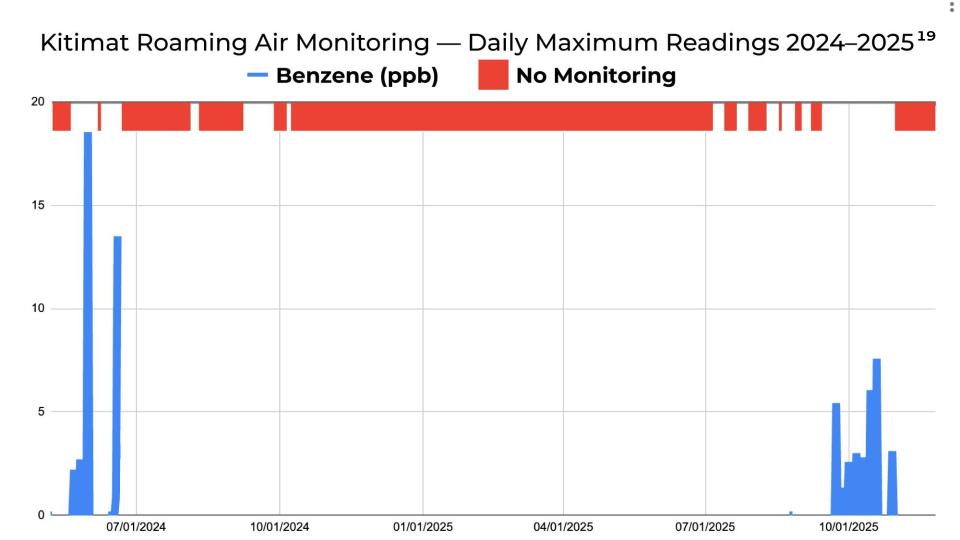
BCER links Roaming Air Monitor deployments for May–November 2024 and July–October 2025, with downloadable reports and data. Its page also links LNG Canada’s October 2025 modelling response, which concluded the additional flaring’s local air-quality effect was small to negligible.
Read the original source ↗Context & questions
A company-submitted modelling report is distinct from an independent health study. Mobile monitoring covers selected places and times. Raw observations need quality flags, units, detection limits, weather and appropriate averaging periods before interpretation.
A question to take forward
Can communities access validated compound-specific data and independent analysis, including short-duration events?
Benzene sampling: a community monitoring lead
Kitimat Airshed Group · supplied October 16 Facebook post
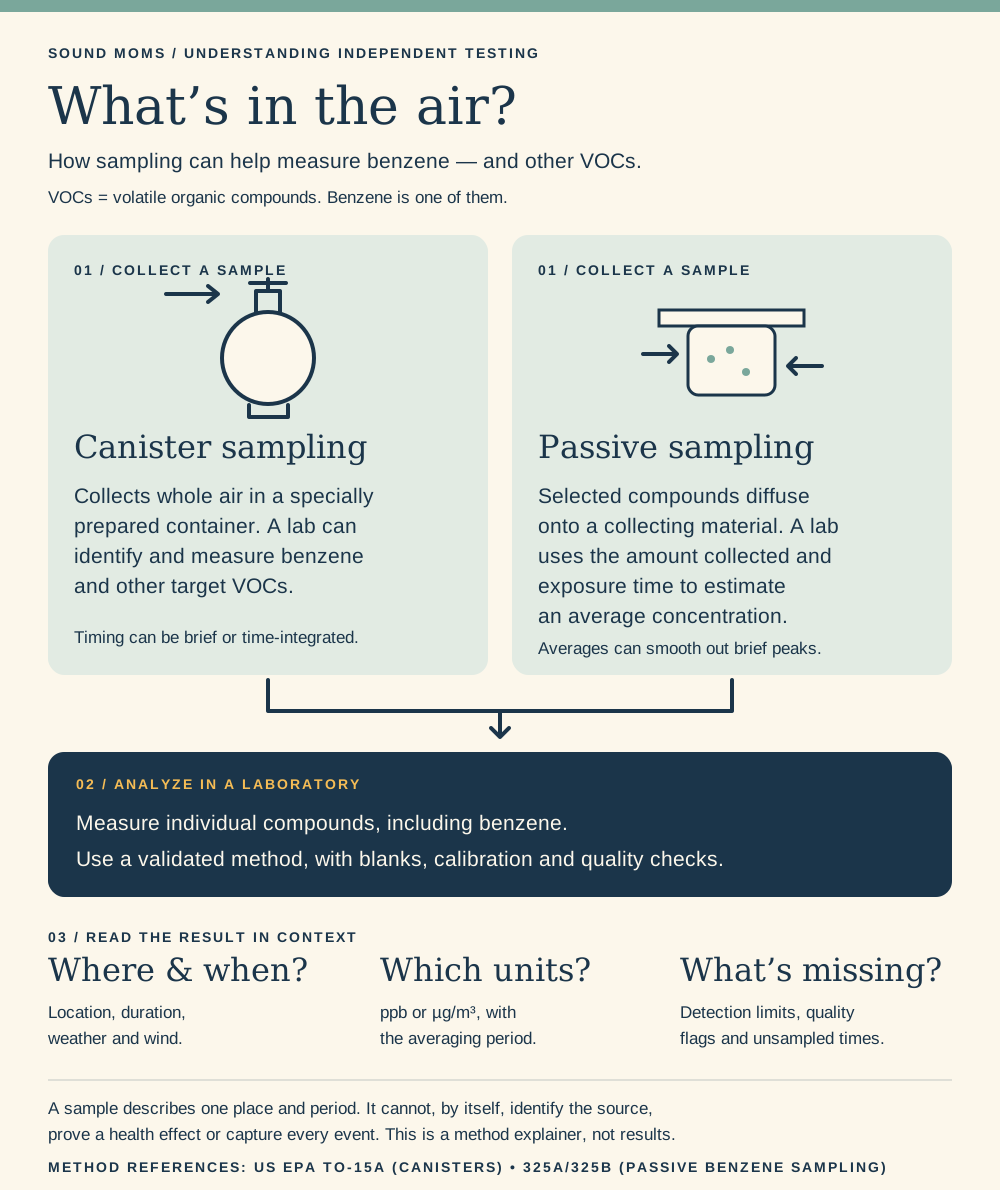
Sampling project announcedKitimat Airshed Group’s October 16 announcement describes passive and canister sampling near Riverlodge, with samples sent for analysis and three phases planned.
Open the supplied post ↗Kitimat Airshed Group website ↗
Context & questions
The linked announcement does not include laboratory results. Checked against the supplied announcement screenshot; the year is supplied with the source and is not visible in the screenshot. The post’s statement about no previous BTEX measurements needs clarification alongside earlier BCER mobile benzene data. It does not establish there was no prior benzene monitoring in Kitimat. The screenshot does not provide lab results, detection limits or a complete sampling protocol.
A question to take forward
How would canister sampling complement continuous monitoring, and who would select events, analyze samples and publish results?
Woodfibre LNG: regulator project information
BC Energy Regulator · project reference
A starting point for the regulator’s project information and linked permits and records.
Read the original source ↗Context & questions
A regulatory reference, not an independent health assessment. Check the dates, scope and conditions of each linked document.
A question to take forward
Which permit conditions address air quality, noise, monitoring and public reporting?
Squamish Nation environmental assessment agreements
Squamish Nation · Rights & Title
The Nation’s own information about its environmental assessment agreements for Woodfibre LNG and the FortisBC project.
Read the original source ↗Context & questions
Read the Nation’s position directly. This resource does not imply endorsement of Sound Moms or replace engagement with the Nation.
A question to take forward
How can community advocacy respect the Nation’s rights, regulatory role and decision-making?
 sound moms